Since 12 August 2026, every packaging item placed on the EU market under Regulation (EU) 2025/40 needs an EU Declaration of Conformity signed by the manufacturer. The document is short, often a single page, but it sits on top of a technical file that can run to dozens of pages per SKU. Get the structure wrong and the declaration is legally invalid, the packaging cannot be marketed, and the manufacturer carries the liability. This guide breaks down what goes into the DoC, what backs it up in the technical file, and how to scale the workflow across thousands of references.
Download the free PPWR Declaration of Conformity template (Annex VIII)
The Annex VIII model structure, blank, with a guidance note under each of the eight points and a one-page "how to complete" sheet: who signs, which Articles 5 to 12 apply today, retention. Word and PDF, no sign-up.
Download the Word template (.docx) Download the PDF
Prefer it filled in for you, with the Annex VII technical file index? Generate it pre-filled, one-time €49.
See the finished document first, not just the field list
Open a fully rendered example declaration — every Annex VIII point completed with clearly fictitious data, watermarked SAMPLE · NOT VALID. That is exactly what you buy, minus the watermark and with your own data.
What is a PPWR Declaration of Conformity?
The PPWR Declaration of Conformity (DoC) is a written self-declaration where the manufacturer states that a specific packaging type meets the sustainability requirements of Articles 5 to 12 of Regulation (EU) 2025/40. It follows the template in Annex VIII and references the technical documentation compiled under Annex VII, Module A. The DoC is mandatory from 12 August 2026 with no grandfathering window.
Which Articles 5 to 12 Requirements Apply Today, and Which Come Later
The Regulation applies from 12 August 2026 (Article 71). That does not make every requirement of Articles 5 to 12 applicable on that date: several start later, or hinge on delegated and implementing acts that have not been adopted yet. A declaration that blanket-certifies conformity with "Articles 5 to 12" certifies something the law does not yet require, and Article 39(5) expects national authorities to check the accuracy of a share of declarations every year.
| Requirement | Applies from |
|---|---|
| Substances in packaging, including heavy-metal limits and the PFAS thresholds for food-contact packaging (Article 5) | 12 August 2026 |
| No double walls, false bottoms or unnecessary layers that only increase perceived volume (Article 10(2)) | 12 August 2026 |
| Requirements for reusable packaging, where relevant (Article 11) | 12 August 2026 |
| Compostability of the packaging listed in Article 9(1), including fruit and vegetable stickers | 12 February 2028 |
| Labelling: material composition and sorting information (Article 12) | 12 August 2028 |
| Recyclability: design for recycling and performance grades (Article 6) | 1 January 2030 |
| Minimum recycled content in plastic packaging (Article 7) | 1 January 2030 |
| Minimisation of packaging weight and volume (Article 10(1)) | 1 January 2030 |
| Recycled at scale (Article 6) | 1 January 2035 |
The dates from 2028 onward are floors, not fixed calendar dates: the Regulation repeatedly ties them to "or [x] months after the entry into force of the relevant act, whichever is the later". Late delegated or implementing acts push the corresponding requirements back. In point 5 of the declaration, name the requirements that apply on the date you place the packaging on the market, not the whole range.
Who Signs the Declaration?
The "manufacturer" in PPWR terms is the legal person who makes the packaging or has it made and markets it under their name or trademark (Article 3). For private-label situations this is often the brand owner, not the converter. Importers who place packaging on the EU market under their own brand are also treated as manufacturers under Article 21. Distributors who repackage or substantially modify packaging step into the manufacturer's shoes too.
This matters because the signature on the DoC carries personal liability for the legal entity, not the individual. Authorised representatives appointed under Article 17 can sign on behalf of non-EU manufacturers, but the underlying technical file still has to exist and be available to market surveillance authorities within reasonable time.
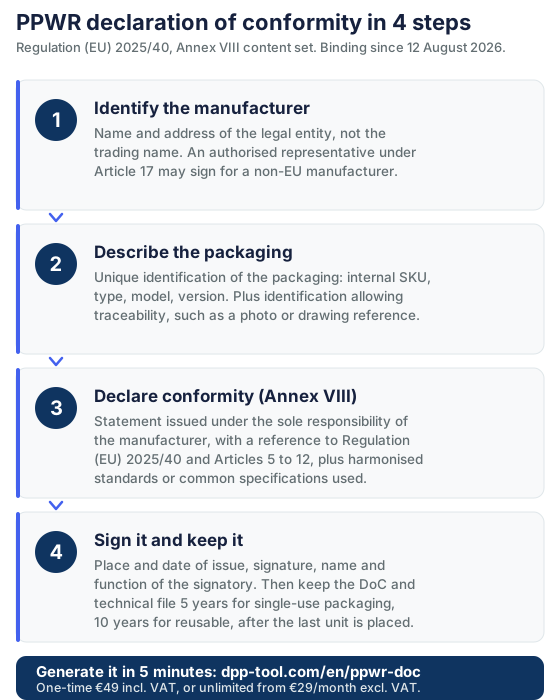
Annex VIII: Mandatory Content of the DoC
The declaration template under Annex VIII is prescriptive. Missing any field renders the DoC invalid, which is treated under PPWR as if no declaration existed at all. The minimum content set:
| Field | Source / Notes |
|---|---|
| Unique identification of the packaging | Internal SKU, type, model, version |
| Name and address of the manufacturer (or authorised representative) | Legal entity, not trading name |
| Statement that the DoC is issued under the sole responsibility of the manufacturer | Verbatim Annex VIII wording |
| Identification of the packaging allowing traceability | Photo or technical drawing reference |
| Reference to Regulation (EU) 2025/40 and applicable articles | The Articles 5 to 12 requirements that apply on the date of placing on the market (see the table above) |
| References to harmonised standards used | EN standards once published |
| References to common specifications used | Where harmonised standards do not exist |
| Place and date of issue | Each revision triggers a new DoC |
| Signature, name and function of signatory | Authorised person within the legal entity |
What a Completed PPWR Declaration of Conformity Looks Like: A Worked Example
The table below shows how a manufacturer would populate each Annex VIII field for a corrugated transport box. All company details are illustrative; the field structure and regulatory references are drawn from Annex VIII of Regulation (EU) 2025/40.
| Annex VIII Field | Illustrative Entry |
|---|---|
| Unique identification of the packaging | Transport box TB-240 v1.2 — corrugated cardboard B-flute, 400 × 300 × 200 mm |
| Manufacturer name and address | Example Packaging GmbH, Industriestraße 12, 20095 Hamburg, Germany |
| Sole responsibility statement | "This declaration of conformity is issued under the sole responsibility of the manufacturer." |
| Identification enabling traceability | Internal drawing reference DP-TB240-2025-03; product photographs held in the Annex VII technical file |
| Reference to Regulation (EU) 2025/40 | Regulation (EU) 2025/40 of the European Parliament and of the Council, Articles 5 to 12 |
| Harmonised standards applied | EN 13427:2004 (requirements for use of European Standards in packaging and packaging waste), EN 13430:2004 (packaging recoverable by material recycling) |
| Common specifications applied | Not applicable — harmonised standards cover the requirements declared above |
| Place and date of issue | Hamburg, 1 June 2026 — version 1.0 |
| Signatory, name and function | A. Müller, Quality Director [signature on original] |
The declaration itself typically fits on one or two pages. A manufacturer with 200 packaging SKUs with different material compositions or supplier chains must produce 200 separate declarations, each referencing its own Annex VII technical file. The technical documentation behind each one can run to dozens of pages.
That arithmetic is the whole decision: 200 declarations at the one-time rate is a different budget from a plan that covers them all. DPP-Tool Pro includes unlimited PPWR declarations and Annex VII technical files at €79/month excl. VAT; the one-time €49 document stays available for a single specification.
To avoid missing a mandatory field, a structured tool that enforces the Annex VIII template helps. DPP-Tool's PPWR DoC generator pre-populates each section from a guided form and produces a document ready for an authorised person to sign, for a one-time €49.
The Technical File Behind the DoC
The DoC is the visible tip. The iceberg is the technical documentation under Annex VII, which the manufacturer must keep current and produce on request. Module A (internal production control) is the standard conformity assessment route, meaning no third-party notified body is involved. The manufacturer assesses internally, signs internally, and is auditable externally.
Annex VII technical documentation includes:
- A general description of the packaging type, intended use, and identification details.
- Drawings, schematics, and material composition (layer by layer for multi-material packaging).
- Supplier declarations covering each raw material, especially regarding substances of concern.
- Conformity assessments demonstrating compliance with recyclability, minimisation, and reusability obligations.
- For food-contact packaging: PFAS test reports from ISO/IEC 17025 accredited laboratories, per the thresholds described in the PFAS ban explainer.
- List of harmonised standards applied and, where standards do not cover a requirement, the alternative solutions adopted.
- Results of design verification, calculations, simulations, and any third-party tests used as evidence.
For a detailed breakdown of each Annex VII element — retention periods (5 years for single-use, 10 years for reusable), the 10-day market surveillance access obligation, and how to structure the file across multiple SKUs — see the PPWR Technical File (Annex VII) compliance guide.
How Long to Keep the Documentation
Retention periods are fixed by PPWR and longer than under the previous directive. For single-use packaging, manufacturers must keep the DoC and technical file for at least five years after the last unit is placed on the market. For reusable packaging, the period extends to ten years. The clock starts not from manufacturing date but from the last placement on the market, which means active product families need rolling documentation upkeep, not a one-off file.
Operationalising the DoC Across Thousands of SKUs
Most manufacturers do not have one packaging type. A mid-sized FMCG brand can have hundreds of primary SKUs, each with its own primary, secondary and transport packaging, and each combination needs its own DoC. The August 2026 deadline forces a scalable workflow. Common pitfalls and how to handle them:
| Pitfall | Mitigation |
|---|---|
| Treating DoC as a template-fill exercise | Build the underlying technical file first; DoC is a downstream artefact |
| Missing supplier data on multi-layer films | Issue PPWR supplier questionnaires immediately, with contractual deadlines tied to August 2026 |
| One DoC for a packaging family across variants | Each unique material specification needs its own DoC; SKU-level granularity |
| No version control | DoCs are dated documents; any change to recyclability grade, recycled content, or PFAS supplier triggers reissuance |
| PDF-only storage with no search | Use a structured database; market surveillance audits are time-bound |
The structured database that holds these declarations is usually the same platform that manages a manufacturer's product passports. For a side-by-side of the options across the price spectrum, from free tiers to enterprise, see our digital product passport software comparison.
Importers and Distributors: Verification Duties
Importers cannot rely on the supplier's word alone. Before placing packaging on the EU market they must verify that the manufacturer has performed the conformity assessment, that the DoC is drawn up, and that the technical documentation exists. Distributors have a lighter due-diligence duty: check the DoC accompanies the packaging where required, and check labelling. Both can become "manufacturers" under Article 21 if they modify the packaging in a way that affects compliance, or sell it under their own brand.
Penalties for Non-Compliance
PPWR delegates the penalty regime to Member States, requiring "effective, proportionate and dissuasive" sanctions. Member States must adopt their penalty rules by 12 February 2027 (Article 68(1)); most have not yet done so. Practical exposure includes administrative fines proportional to turnover and mandatory recall of non-compliant stock.
How the DoC Integrates with the Digital Product Passport
The DoC is text-based today but PPWR allows electronic formats. A natural evolution is to host the DoC behind the QR code data carrier that becomes mandatory from August 2028. Brands already building a DPP for packaging can attach the DoC as a structured field, giving market surveillance authorities, recyclers and consumers a single scan path. The same approach is being used for batteries under Regulation (EU) 2023/1542, see the battery passport guide for the precedent.
Manufacturers placing batteries on the EU market face a parallel technical documentation burden — the EU Battery Passport mandates 90+ data fields, a certified QR data carrier, and a compliance deadline of 18 February 2027. For the full infrastructure checklist and timeline, see the EU battery passport guide.
Generate your PPWR Declaration of Conformity in minutes
DPP-Tool automates the Annex VIII DoC template for every packaging SKU — pre-filled with the mandatory fields, exportable as PDF, and linked to your Annex VII technical file index. Start free, generate a single DoC for a one-time €49, or cover a whole range with Pro.
Frequently Asked Questions
Can one Declaration of Conformity cover multiple packaging SKUs?
Only if the SKUs share the exact same material composition, structure and supplier chain. Different ink coverage, different label adhesives, or a different barrier-layer supplier means a different DoC. Most manufacturers will end up with one DoC per unique packaging specification.
Does the DoC need to be physically with the packaging?
Not on the unit itself. The DoC must be made available to market surveillance authorities on request, and accompany the packaging through the supply chain in a way that distributors and importers can access it. Electronic delivery is acceptable.
Who is liable if the supplier provides false data?
The manufacturer signing the DoC carries primary liability towards authorities. Contractual recourse against the supplier is a separate civil matter. This is why PPWR-grade supplier agreements typically include audit rights, indemnification clauses, and termination triggers tied to non-compliance.
Do reusable packaging systems need a DoC per cycle?
No. The DoC is issued when the packaging is first placed on the market. Reusable systems need a DoC covering the design and intended reuse cycles, plus documentation of the reuse system itself under Article 11. Retention runs ten years.
Is there an official PPWR Declaration of Conformity template?
The official model is Annex VIII of Regulation (EU) 2025/40 itself: eight numbered points and a signature block, with no separate form published by the Commission. The free template on this page reproduces that structure in Word and PDF, adds a guidance note under each point (including which Articles 5 to 12 apply on the date you sign) and can be used as it is. The generator produces the same declaration pre-filled with your data, together with the Annex VII technical file index.
What does a completed PPWR Declaration of Conformity look like?
A completed DoC follows the Annex VIII structure and typically fits on one or two pages. It states the manufacturer's identity, describes the specific packaging type (dimensions, materials, internal reference), identifies which Articles 5 to 12 requirements are declared as met, lists harmonised standards applied, and closes with a signed declaration of sole responsibility including the signatory's name and function. The worked example table in this article shows all mandatory fields populated for a corrugated transport box. For reusable or composite packaging, the same structure applies with additional fields covering reuse cycles or multi-material composition.